
Search Middlesex County Court Records Online
The official starting point is the Connecticut Judicial Branch Case Look-up menu. It divides court records by court level and case type, including appellate records, Superior Court civil and family matters, housing, small claims, criminal and motor vehicle matters, and centralized small claims. Middlesex County court records are not stored in a separate county court website because Connecticut uses a state Judicial Branch structure.
For civil, family, housing, and small claims matters, use the Superior Court Civil/Family/Housing/Small Claims Case Look-up. For criminal and motor vehicle matters, use the Judicial Branch criminal and motor vehicle lookup options. Select MMX-Middletown JD or Middletown Geographical Area 9 when the form lets you narrow the location. Probate records use the Connecticut Probate Court system, and federal cases use federal court systems.
The Superior Court civil lookup home screen is one of the assigned source captures for Middlesex County court records.
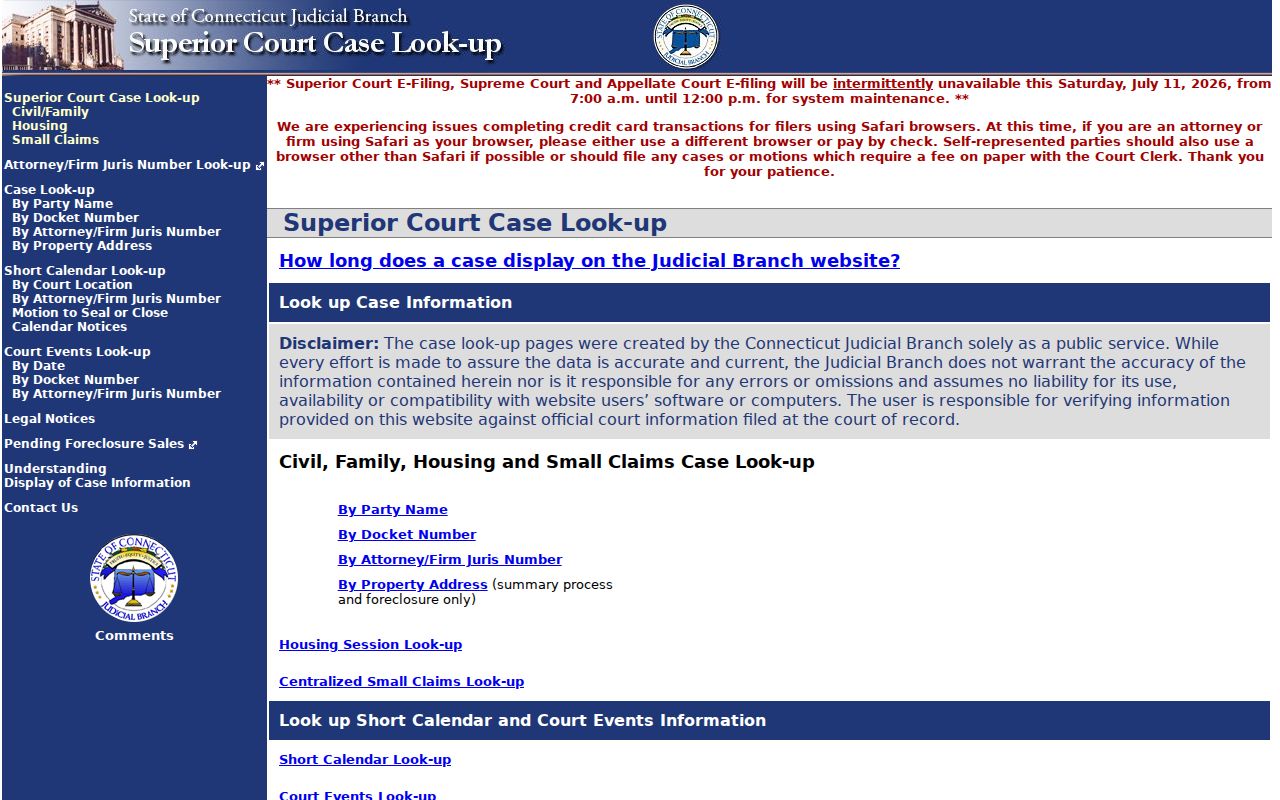
This source is useful because many Middlesex civil and family court records begin with the statewide civil inquiry portal, not a county database.
- Decide whether the case is civil, family, housing, small claims, criminal, motor vehicle, probate, appellate, or federal.
- Open the Judicial Branch case lookup menu and choose the matching official search system.
- For civil and family records, search by party name or docket number and choose MMX-Middletown JD when narrowing the location.
- For criminal and motor vehicle records, search pending cases, daily dockets, docket numbers, or convictions, and check both Middlesex JD and Middletown GA 9 when relevant.
- Use the docket number and case caption when asking the Clerk of the Superior Court for copies or certified records.
Middlesex County Court Records Search Fields
The civil and family party search is the best field table for a broad Middlesex County court records lookup because it covers several common record types and gives location and case-type filters. The party last name is required. Other fields help narrow a common name, distinguish civil from family cases, or focus on the Middletown Judicial District location code.
The civil and family party search form shows the fields used for party-name searches in Superior Court records.
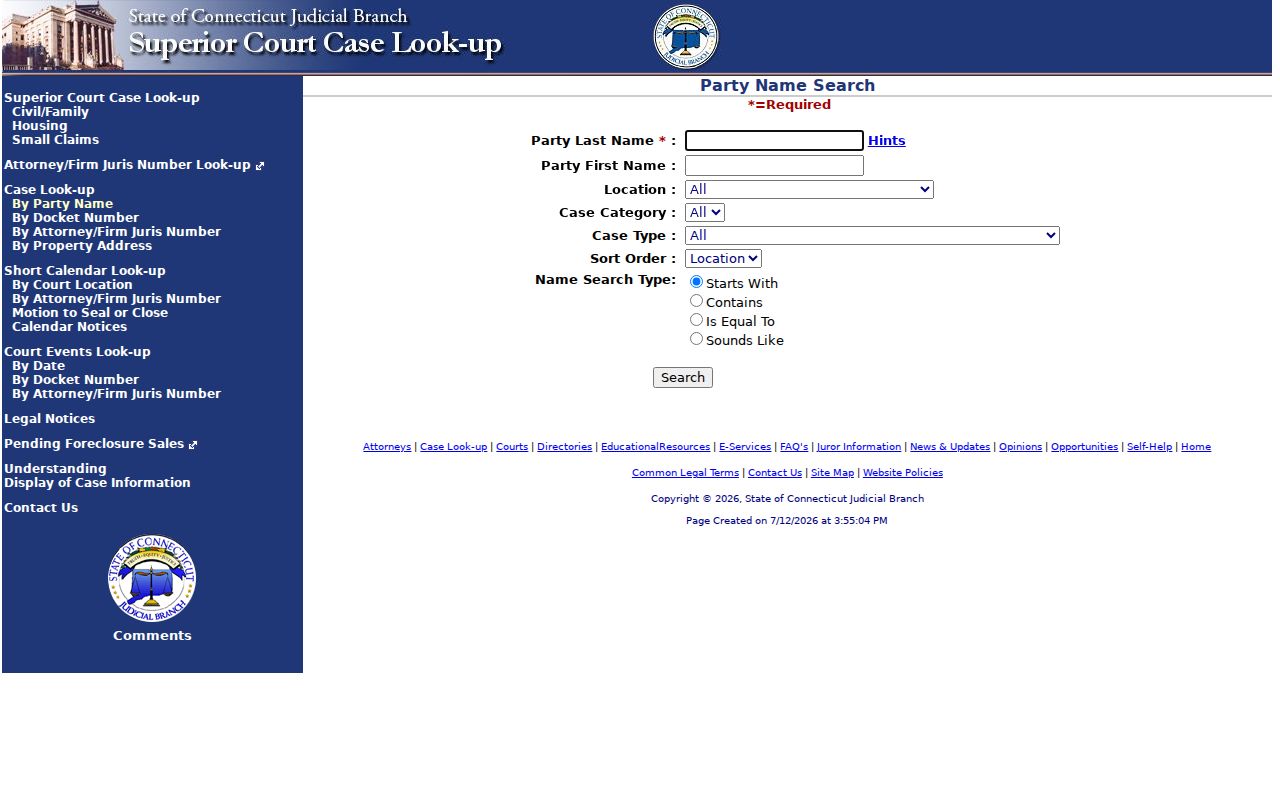
The party-search form matters for Middlesex County court records because family and civil case access often starts with a name, then moves to a docket number for copy requests.
| Field Label | Type | Required | Notes / Format |
|---|---|---|---|
| Party Last Name | Text | Yes | Required field, with a maximum length of 54 characters and a hints link beside the entry box. |
| Party First Name | Text | No | Optional field with a maximum length of 50 characters, useful for narrowing common names. |
| Location | Dropdown | No | Use All for a statewide search or MMX-Middletown JD for Middlesex Judicial District matters. |
| Case Category | Dropdown | No | All, CV for civil, or FA for family matters. |
| Case Type | Dropdown | No | Examples include collections, zoning, tax, dissolution of marriage, custody, name change, and relief from physical abuse. |
| Search | Button | n/a | Submits the lookup and returns matching public case information when available. |
The civil docket number search is the more direct route when the docket number is already known.
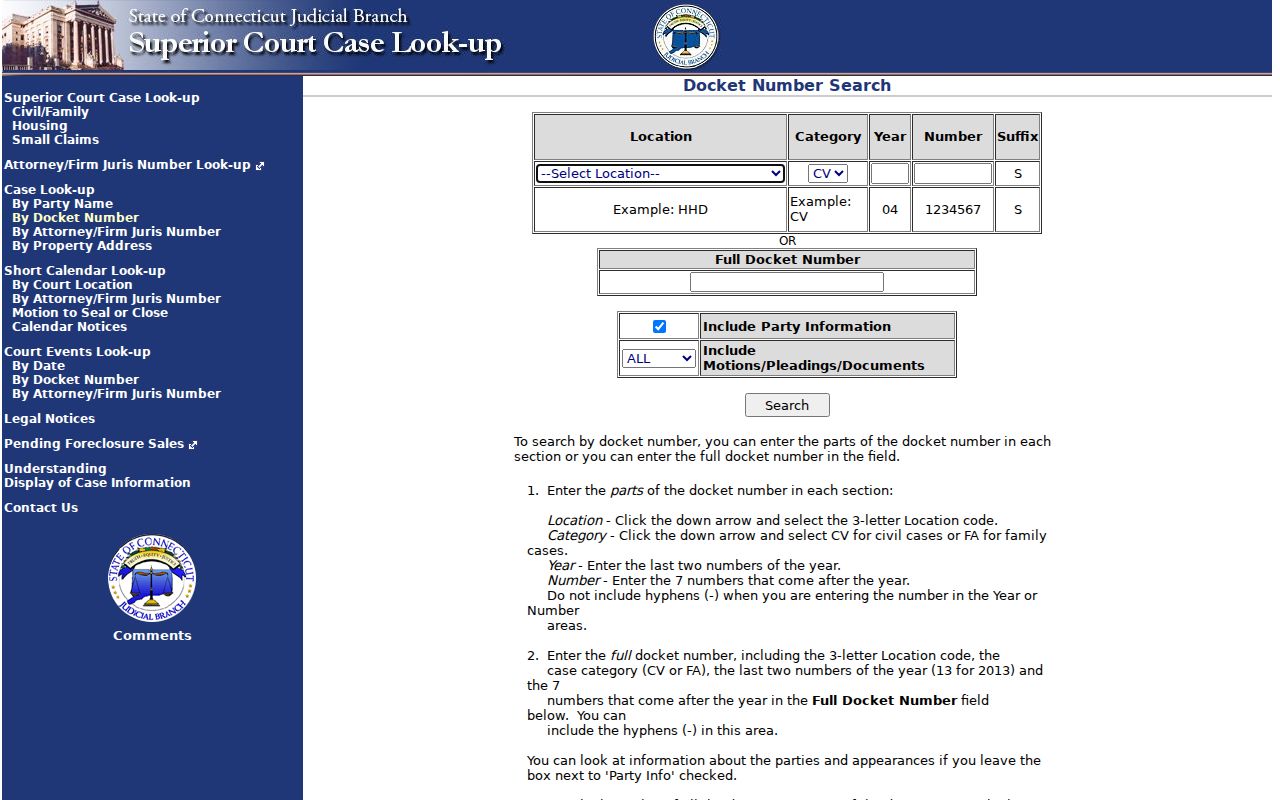
Docket-number searches are often the cleanest way to return the exact Middlesex court record after a name search finds several possible matches.
Types of Middlesex County Court Records
Middlesex County court records include several state court record types. Civil records may involve complaints, appearances, motions, orders, judgments, executions, administrative appeals, foreclosures, collections, tort claims, contract cases, zoning appeals, and tax appeals. Family records include dissolution, legal separation, annulment, custody, visitation, support, relief from abuse, foreign matrimonial judgments, and name changes.
Criminal and motor vehicle court records are searched in a different Judicial Branch system. That system can show pending cases, daily dockets, convictions, charges, docket numbers, locations, dispositions, pleas, sentencing entries, and some warrant-related events. Probate records are separate from Superior Court and use Connecticut Probate Court lookup tools. Juvenile, adoption, child protection, and some family or mental health records are not ordinary public court records.
- Civil records cover CV-coded matters such as contracts, collections, foreclosures, torts, zoning, tax, and administrative appeals.
- Family records cover FA-coded matters such as dissolution, custody, support, name change, and relief from physical abuse.
- Criminal court records cover charges, pleas, docket events, dispositions, sentencing, and conviction information where public.
- Motor vehicle court records cover court-required traffic and motor vehicle cases, separate from DMV driving history.
- Probate records cover estates, trusts, fiduciaries, conservatorships, guardianships, and other Probate Court matters.
What Middlesex County Court Records Show
A public case lookup is usually case information, not a full document download system. The docket gives enough detail to identify the case, follow events, and ask the clerk for a specific record. Full pleadings, certified copies, exhibits, and older documents may require a clerk request at the courthouse.
| Field | What It Shows |
|---|---|
| Docket number | The official case identifier used by the clerk and the online lookup systems. |
| Court location | The place or code tied to the case, such as MMX-Middletown JD or Middletown GA 9. |
| Case category/type | The broad record class, such as civil, family, criminal, motor vehicle, housing, small claims, or probate. |
| Party names | Names such as plaintiff and defendant, petitioner and respondent, state and defendant, or fiduciary and decedent where public. |
| Status or disposition | Whether the case is pending, disposed, dismissed, convicted, nolled, stayed, sealed, erased, or otherwise resolved where shown. |
| Docket events | Appearances, motions, orders, hearings, continuances, judgments, sentences, payment events, warrants, and short-calendar activity. |
| Documents | Whether a public event exists, while copies and certified documents usually require a clerk request. |
Public Access to Middlesex County Court Records
Connecticut public access starts with the rule that public records are generally open unless a federal law, state law, court rule, court order, or statutory exemption limits release. The Connecticut FOI Act includes Conn. Gen. Stat. Sec. 1-210 for public records and Sec. 1-212 for inspection and copy fees. Court records, however, are also controlled by Judicial Branch procedures and case-specific confidentiality rules.
The Connecticut General Statutes Chapter 14 source is assigned to this Middlesex County court records page.
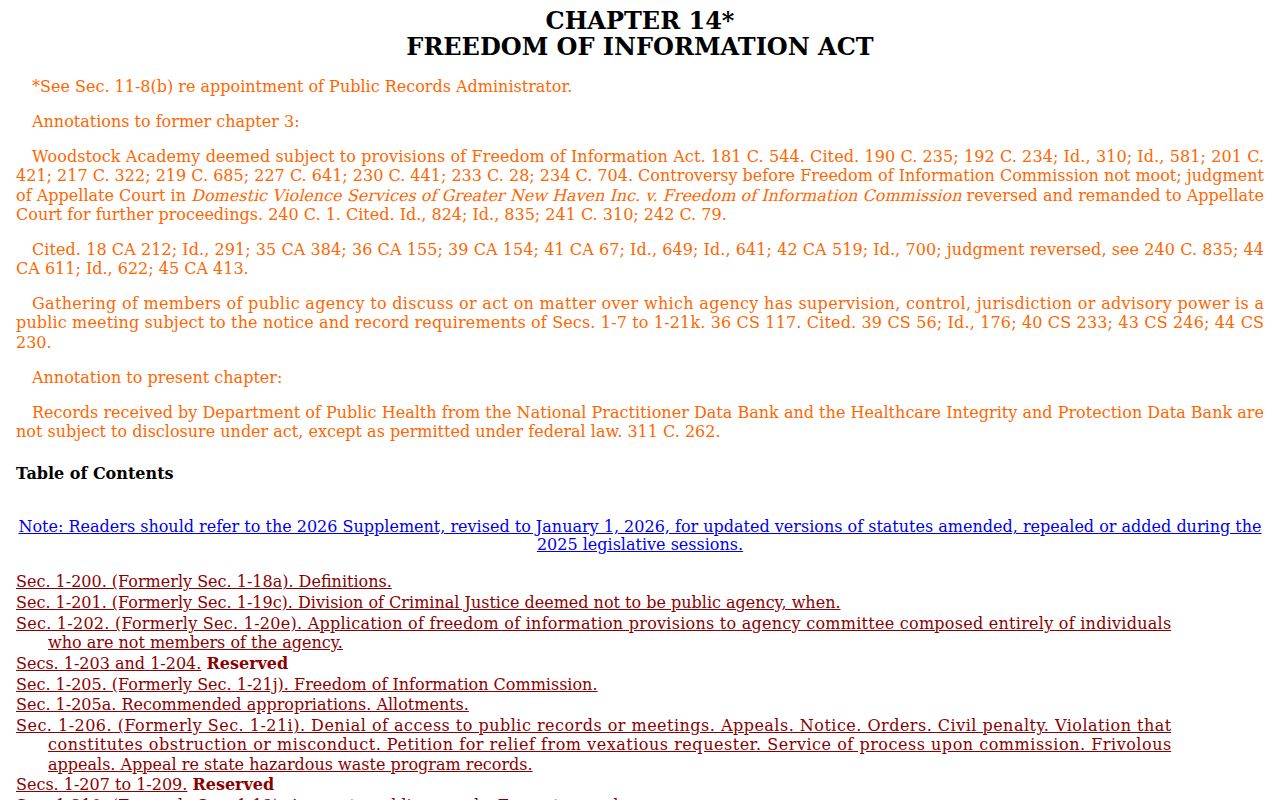
Those statutes help explain why many records are public while court-specific sealing, erasure, and confidentiality rules still control sensitive case files.
For records that are not online, the access path is practical: search online first for the docket number, then contact or visit the Clerk of the Superior Court with the case name, docket number, requested document, and return contact information. Probate records go through the correct Probate Court. Police arrest reports may be requested from the arresting police department under FOIA, but court charges and court dockets are searched through Judicial Branch systems.
Note: Online case lookup is not the same as a certified copy from the Clerk of the Superior Court.
Restricted Middlesex County Court Records
Some Middlesex County court records are not released through ordinary public lookup. Juvenile matters are confidential under Conn. Gen. Stat. Sec. 46b-124. Erased criminal records are removed from public disclosure under Conn. Gen. Stat. Sec. 54-142a. Youthful offender records, sealed files, adoption records, mental health proceedings, protected addresses, minors' information, Social Security numbers, financial account data, and victim-protected details may be withheld or redacted.
The Judicial Branch ADA accommodation source is also assigned to this page because access can involve more than a database search.
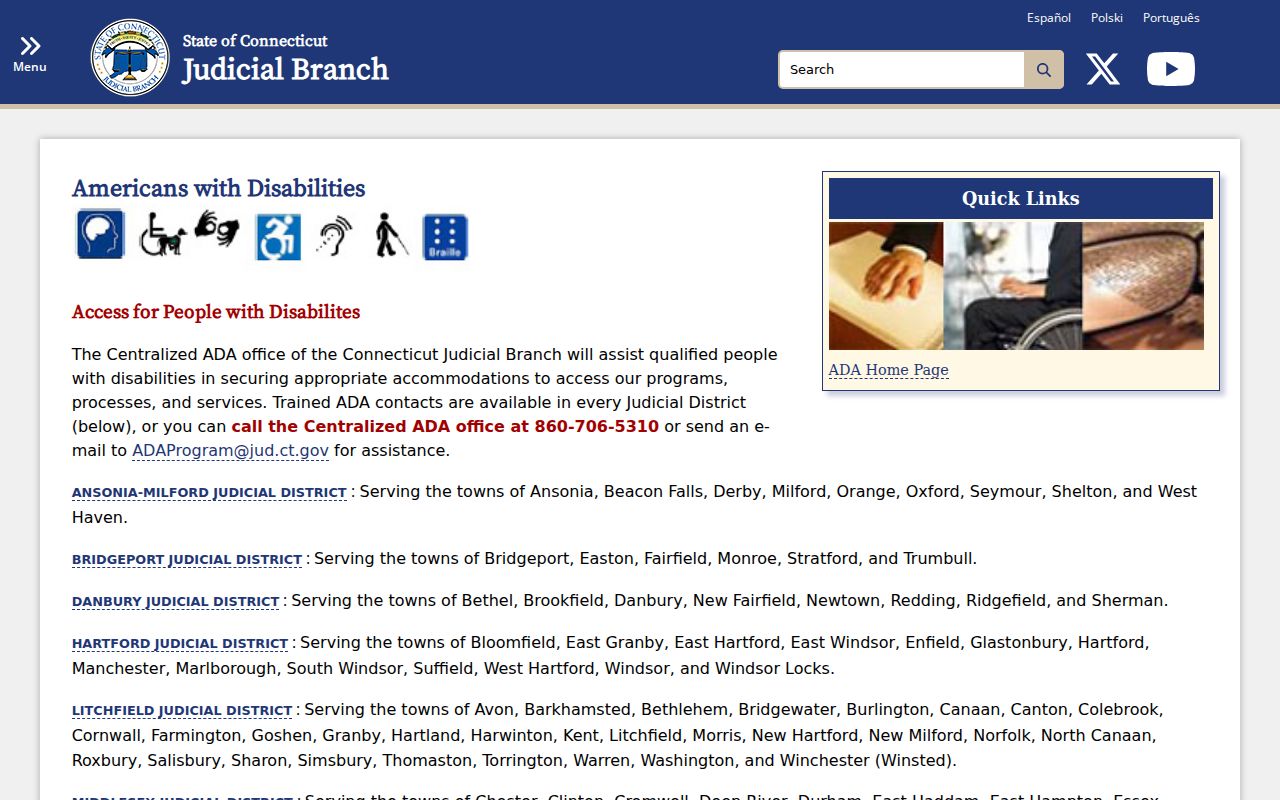
Accommodation and access rules matter when a person needs to visit the courthouse to inspect records or request copies.
Clean Slate erasure can also affect search results. Connecticut reported that erasures resumed after delays related to aging data systems and data quality. A missing criminal result does not always prove no record ever existed. It may be sealed, erased, juvenile, youthful offender, too old for public display, or entered under a different name or docket number.
Family and civil searches have their own limits too. A family case may show the case type, status, and public events while keeping financial affidavits, protected addresses, domestic violence details, or minors' information out of public view. A civil file may show a judgment or motion entry online while the filed document itself must be requested from the clerk. Those limits are part of the record system, not a sign that the search failed.
In-Person Court Record Requests
The in-person fallback for Superior Court records is the Clerk of the Superior Court at the Middlesex Judicial District courthouse. Bring the docket number if possible, plus the party names, case type, document name, and your contact information. For certified copies, the clerk needs enough detail to locate the file and calculate any copy or certification cost from the current Judicial Branch fee schedule.
Do not ask the Superior Court clerk for land records, town vital records, or marriage certificates. Connecticut town clerks, local registrars, and the Department of Public Health handle those records. Divorce decrees, custody orders, civil judgments, criminal convictions, motor vehicle dockets, and court filings belong in the Superior Court or Judicial Branch record path.
Mail requests should use the courthouse address and identify the case caption, docket number, requested filing, certification need, and return contact. Phone contact is useful before mailing payment because the current fee may depend on the document type, page count, certification, and whether the file is available at the counter or must be retrieved.
Clerk of the Superior Court
1 Court Street
Middletown, CT 06457
860-343-6400
9:00 a.m. to 5:00 p.m.; doors open at 8:30 a.m.