
Middlesex County Arrest Records and Charges
Middlesex County arrest records begin with the arresting police agency. They may involve arrest reports, booking notes, custody status, or municipal and state police information. The court charge record starts when charges enter the Superior Court or Geographical Area court path. That distinction matters because Connecticut does not provide a Middlesex County sheriff mugshot site or county jail roster.
After an arrest, police submit information and the State's Attorney decides how the case proceeds. The charges are then tracked in the criminal or motor vehicle court docket. For custody status, use DOC inmate information. For the full case file, pleas, disposition, and sentence, use Middlesex County criminal court records. For all court record types, use Middlesex County court records.
Find Middlesex County Arrest Records
The court charge path uses the Connecticut Judicial Branch criminal and motor vehicle lookups. A pending charge can be searched by defendant name, docket number, daily docket, or conviction search depending on the stage of the case. For Middlesex matters, check Middlesex Judicial District and Middletown Geographical Area 9 when location filters are available.
Use this search order when moving from arrest to court charges:
- Identify whether the person was arrested, cited and released, held in DOC custody, or already given a court date.
- Search the criminal and motor vehicle pending defendant lookup by last name, then narrow by first initial, birth year, court location, and category type.
- Check the daily docket by court location if the court date is near or the person is newly arraigned.
- Use the docket number search when a citation, notice, or clerk communication gives the docket number.
- Read the charge status and disposition before treating a charge as an outcome.
Police arrest reports may require a request to the arresting police agency under Connecticut public-record rules. Court charges, by contrast, are Judicial Branch court records. Custody status belongs in the statewide Connecticut DOC inmate search, not a Middlesex County jail site.
Middlesex County Charges After Arrest
The charge record begins after police action moves into prosecution. Connecticut calls the local prosecutor the State's Attorney, not the district attorney. The Middlesex Judicial District State's Attorney is Michael A. Gailor. The State's Attorney's office prosecutes criminal offenses that occur in the district and handles felonies, misdemeanors, motor vehicle crimes, violations of probation, and related proceedings.
The research assigns the Connecticut State's Attorneys overview to this arrest and charge page.
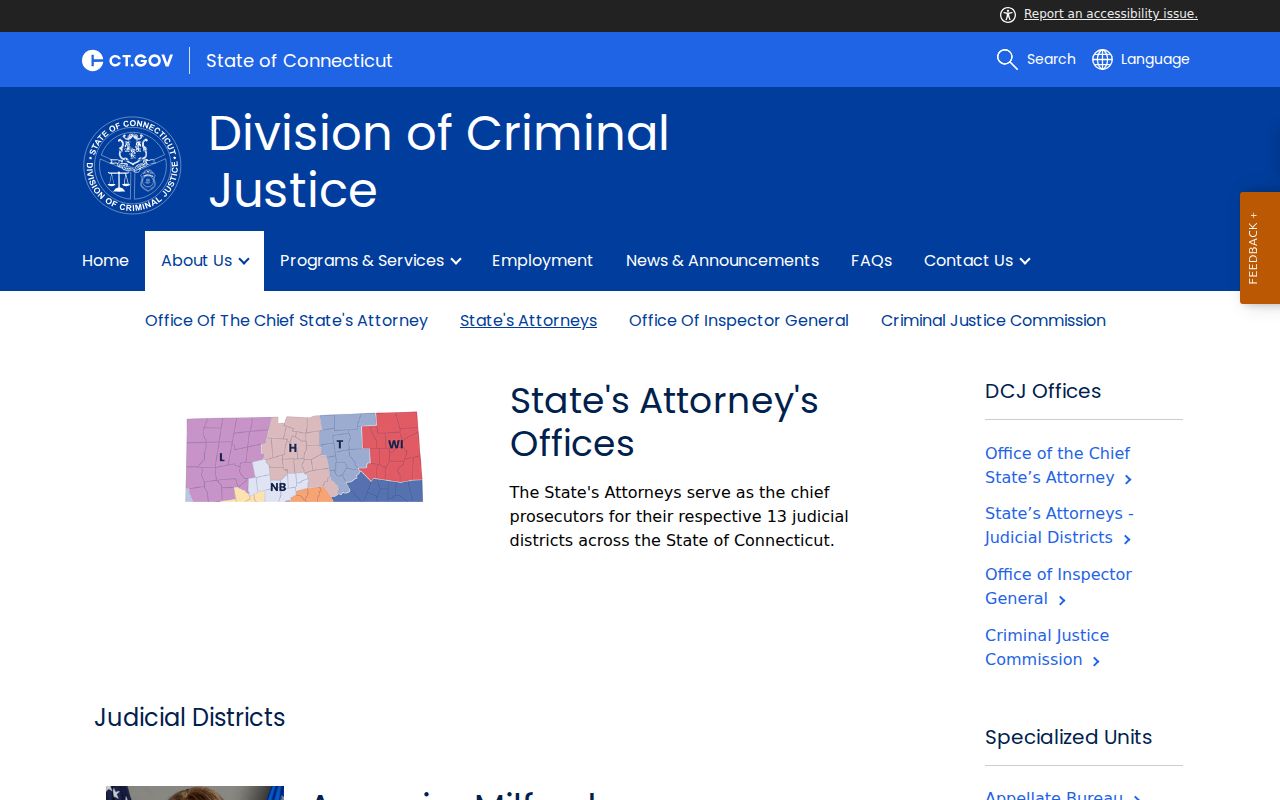
The State's Attorney source explains why court charges after arrest are prosecuted through a state judicial district office rather than a county district attorney.
| Charging Document | Who Uses It | What It Does |
|---|---|---|
| Complaint | Law enforcement or prosecutor path | Starts or supports a criminal accusation based on alleged conduct. |
| Information | Prosecutor | States formal criminal charges the prosecutor chooses to pursue in court. |
| Indictment | Formal charging route in serious cases | Identifies serious charges when that charging process applies. |
Middlesex County Court Charge Status
Charges can change after the first court appearance. A filed charge may remain pending, be amended, reduced, dismissed, nolled, or end in conviction. A single arrest can also produce more than one charge. The safest reading method is to follow each charge from filing through final disposition.
| Status | What It Means |
|---|---|
| Pending | The charge is open and has not reached a final public outcome. |
| Amended | The charge changed after filing, often because the prosecutor or court record was updated. |
| Reduced | The charge moved to a lesser charge or lower severity level during the case. |
| Dismissed | The charge ended without a conviction on that charge. |
| Nolle | The prosecutor decided not to proceed on that charge at that time. |
| Convicted | The charge resulted in a guilty plea or formal finding of guilt. |
Middlesex County Charge vs Conviction
A charge is not proof of guilt. It is the formal accusation. A conviction is the result after a guilty plea or finding of guilt. Middlesex court charge records may show charges that were dismissed, reduced, nolled, or erased later, so the final disposition is the key field.
| Charge | Conviction | |
|---|---|---|
| Role | Formal accusation after arrest or referral. | Final guilty outcome by plea or finding. |
| Where seen | Pending criminal or motor vehicle lookup and docket events. | Disposition, sentence, and conviction search where public. |
| Can change | Yes, it can be amended, reduced, dismissed, or nolled. | It can later be affected by erasure, pardon, or sealing rules. |
| How to verify | Read all charge events and current status. | Read disposition and sentence entries or ask the clerk for official proof. |
Middlesex County Charge Review Offices
The State's Attorney prosecutes the charges. The Public Defender represents eligible indigent defendants. These offices are distinct from the Clerk of the Superior Court, which maintains the docket and court file. The research identifies the Middlesex J.D. public defender office at 1 Court Street in Middletown, with supervisor Angela C. Anastasi and telephone 860-343-6480.
The Middlesex State's Attorney district includes Middletown, Chester, Clinton, Cromwell, Deep River, Durham, East Haddam, East Hampton, Essex, Haddam, Killingworth, Middlefield, Old Saybrook, Portland, and Westbrook. That municipality list matters because a police arrest in one of those towns can produce a state criminal case in the Middlesex judicial district or Middletown GA 9, while the original arrest report may remain with the arresting municipal or state police agency.
The Public Defender Services judicial district office directory is assigned as an image source for this page.
The public defender source helps place charge records in the court process because defense counsel may appear after arraignment or eligibility screening.
Middlesex County Arrest Records vs Custody
Connecticut has no Middlesex County jail roster. People arrested in Middlesex cases move through police booking, court arraignment at the correct Superior Court or GA location, and Department of Correction custody when held pretrial or sentenced. The correct statewide inmate search is the Connecticut Department of Correction Inmate Information Search.
A person can have court charges without appearing in DOC custody if they were cited and released, released on bond, or not yet reflected in DOC data. A person can also appear in custody while the court docket is still updating. The arresting police agency may hold an arrest report, but the court charge record belongs in the Judicial Branch criminal or motor vehicle docket.
Note: No official Middlesex County sheriff app or county jail booking database was documented in the research.
Sealed Middlesex County Charge Records
Public charge records can be limited by juvenile confidentiality, youthful offender rules, sealing orders, and criminal erasure. Under Conn. Gen. Stat. Sec. 54-142a, qualifying criminal records can be erased after not-guilty findings, dismissals, pardons, and other qualifying events. Juvenile matter records are confidential under Conn. Gen. Stat. Sec. 46b-124.
| Sealed | Erased | |
|---|---|---|
| Public lookup | Hidden or limited because a law or court order restricts access. | Removed from ordinary public disclosure once eligible and processed. |
| Common reason | Juvenile, protected, sensitive, or court-ordered confidentiality. | Dismissal, not-guilty finding, pardon, or qualifying Clean Slate event. |
| Reader takeaway | A missing record may still exist in a restricted court file. | A missing record may have been erased and not released as a public record. |
Public Middlesex County Charge Records
Connecticut public-record law begins with Conn. Gen. Stat. Sec. 1-210, but court charge access is controlled by Judicial Branch systems, court rules, sealing, erasure, and statutory confidentiality. Police reports may be requested from police agencies under FOIA rules. Court charge status must be checked in the criminal and motor vehicle court systems.
The conviction lookup has display limits. The research states that criminal conviction records are generally displayed no more than 10 years after sentencing, and youthful offender cases, juvenile cases, and infraction or violation convictions do not appear in the public conviction lookup. The pending lookup is better for open charges; the conviction lookup is better for completed public conviction records.
Copy requests should start with the public docket data. A docket number, party name, charge or case type, and court location help the Clerk of the Superior Court identify the correct file and determine whether the requested document is public, sealed, erased, or restricted.
Restricted Middlesex County Arrest Records
Restricted arrest and charge information may include juvenile matters, youthful offender records, sealed records, erased cases, protected victim details, protected addresses, minor names, medical information, mental health information, Social Security numbers, and law-enforcement-only records. Search warrants, sealed warrants, and some police investigative materials may not appear in public court charge searches.
For official copies, start with the docket number and the Clerk of the Superior Court. For an arrest report, contact the arresting police agency. For current custody, use Connecticut DOC. Those three systems answer different questions, and combining them avoids treating an arrest, a charge, a conviction, and a custody status as the same thing.
Clean Slate and erasure rules can make public charge searches harder to interpret. A charge that once appeared online may later be erased after a dismissal, not-guilty finding, pardon, or qualifying event. A missing result can also mean the case is too new, searched under the wrong court location, entered under a different spelling, or tied to a nonpublic juvenile or youthful offender record.