
Middlesex County Court Dockets Defined
A docket is the court's running index of a case or calendar. It is built from entries such as filings, hearings, orders, continuances, judgments, pleas, dispositions, and sentencing events. In Middlesex County, those records are state court records because Connecticut uses the Superior Court and Judicial Branch systems, not a county court or county-run filing model.
A docket can answer practical questions quickly: where a case is pending, whether a hearing is scheduled, what docket number to use, whether a matter was disposed, and which court location handled the event. A full case file is broader. It can include pleadings, motions, exhibits, written orders, transcripts, and certified copies that may not appear in the public lookup.
| Record | Best Use | Typical Access |
|---|---|---|
| Docket | Track case events, dates, status, and court location. | Often free through the Judicial Branch lookup system. |
| Full case file | Review filed documents, orders, and certified copies. | May require a clerk request or courthouse visit. |
| Daily calendar | Find cases scheduled at a court location for a court day. | Criminal and motor vehicle dockets can be searched by court location. |
Middlesex County Daily Court Dockets
The Criminal/Motor Vehicle Daily Docket by Court is the official public route for daily criminal and motor vehicle calendars. The search asks for a court location. Middlesex users should select Middlesex Judicial District or Middletown Geographical Area 9 when looking for local criminal and motor vehicle court activity.
The daily criminal and motor vehicle docket source is assigned to this page.
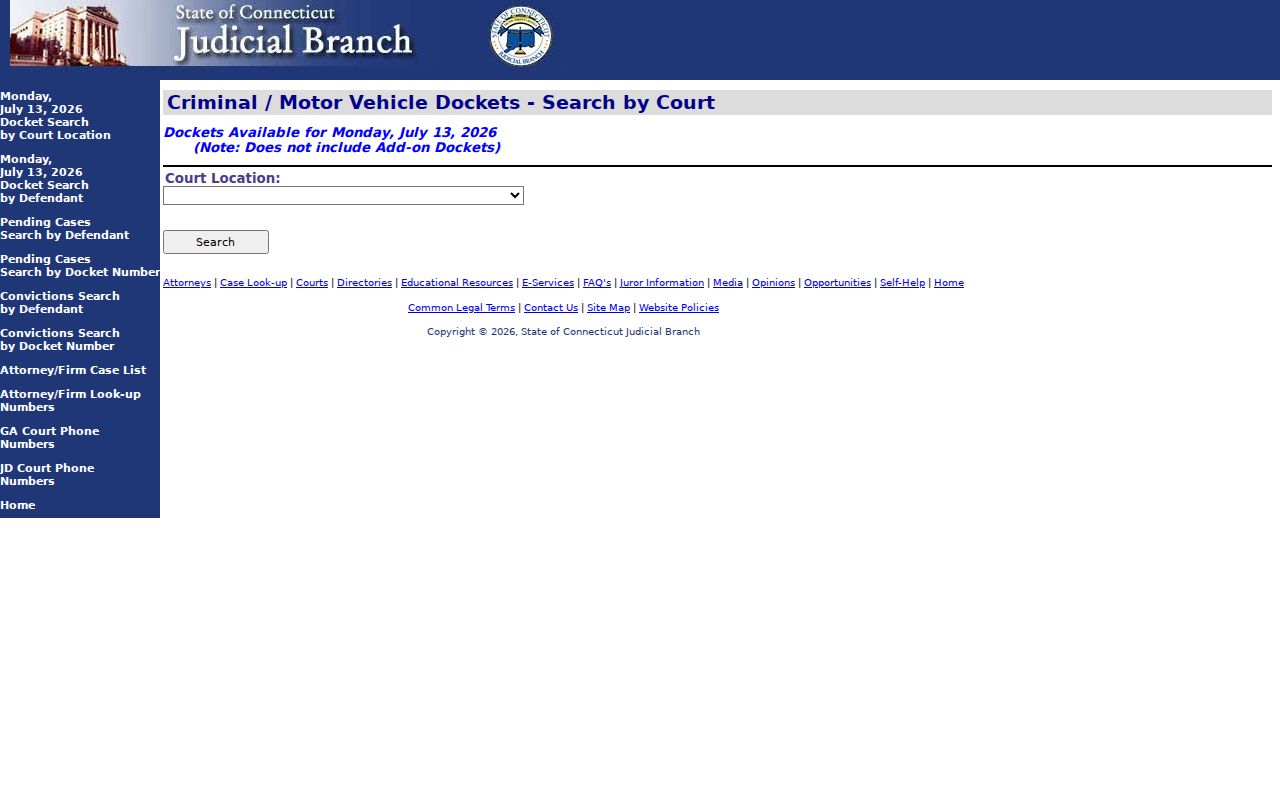
Daily docket lookup is useful when a defendant has an appearance date or when a case is expected to be called in Middletown.
- Open the daily docket search by court location.
- Select the local criminal or motor vehicle court location, such as Middlesex JD or Middletown GA 9.
- Submit the search and review the cases scheduled for that location.
- Use the docket number, defendant name, and court location to confirm details with the Clerk of the Superior Court if needed.
Daily dockets can change. A continuance, plea, bond change, warrant event, or transfer may affect whether a case appears on a given court date.
Search Middlesex County Docket Numbers
When a docket number is known, the docket-number route is usually more precise than a name search. The pending criminal and motor vehicle docket-number search is for pending matters. Civil and family matters use the civil docket number search in the Superior Court civil inquiry system.
The pending criminal docket-number source is one of the assigned images for Middlesex County court dockets.
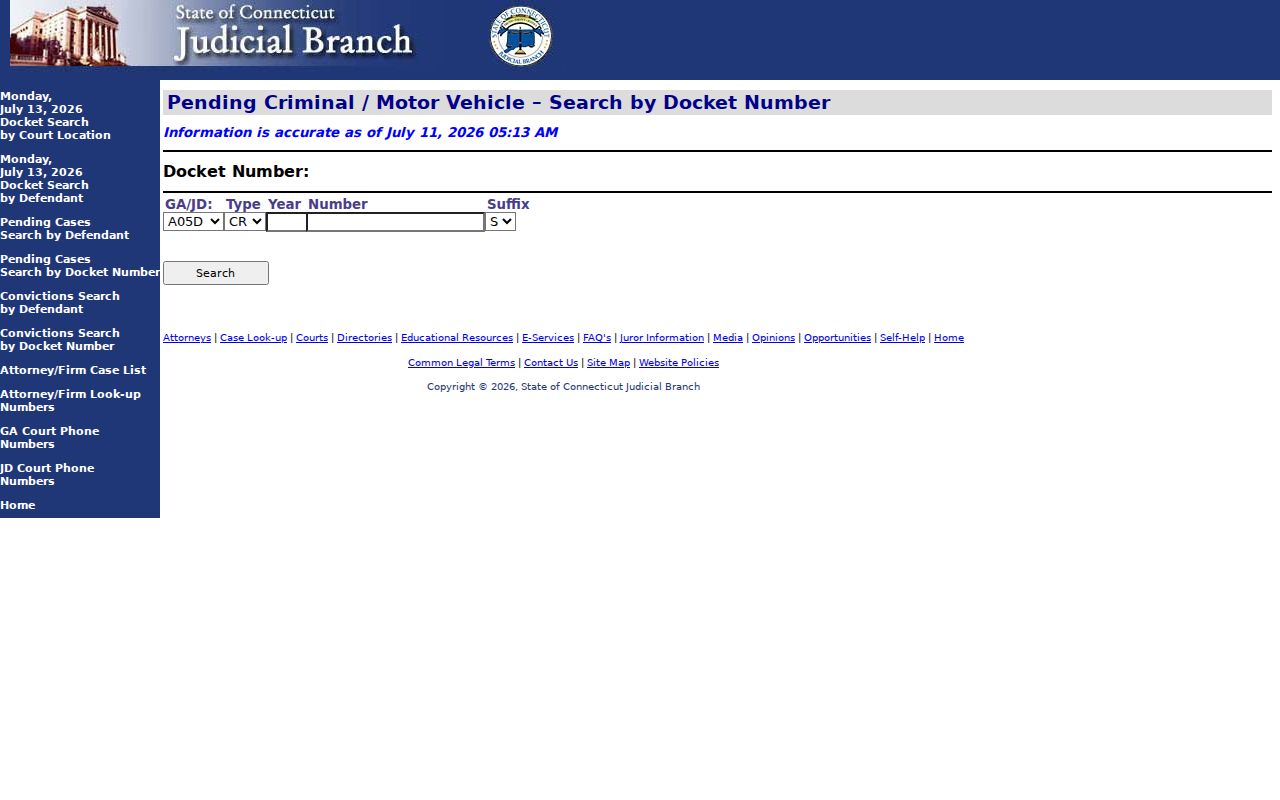
A docket-number search helps avoid name confusion when several defendants or parties have similar names in statewide Connecticut records.
Docket numbers also matter for certified copies. The Clerk of the Superior Court can work faster when the request identifies the docket number, party name, case type, document requested, and return contact. Online docket information should be treated as a locator for the official record, not a substitute for a certified clerk copy.
Middlesex County Conviction Dockets
The Judicial Branch also provides a criminal and motor vehicle convictions search by defendant. The research notes that criminal conviction records are generally displayed no more than 10 years after sentencing, subject to Practice Book limits and erasure. Youthful offender cases, juvenile cases, and infraction or violation convictions are not shown in that conviction lookup.
The conviction search source is assigned to the Middlesex County court dockets page.
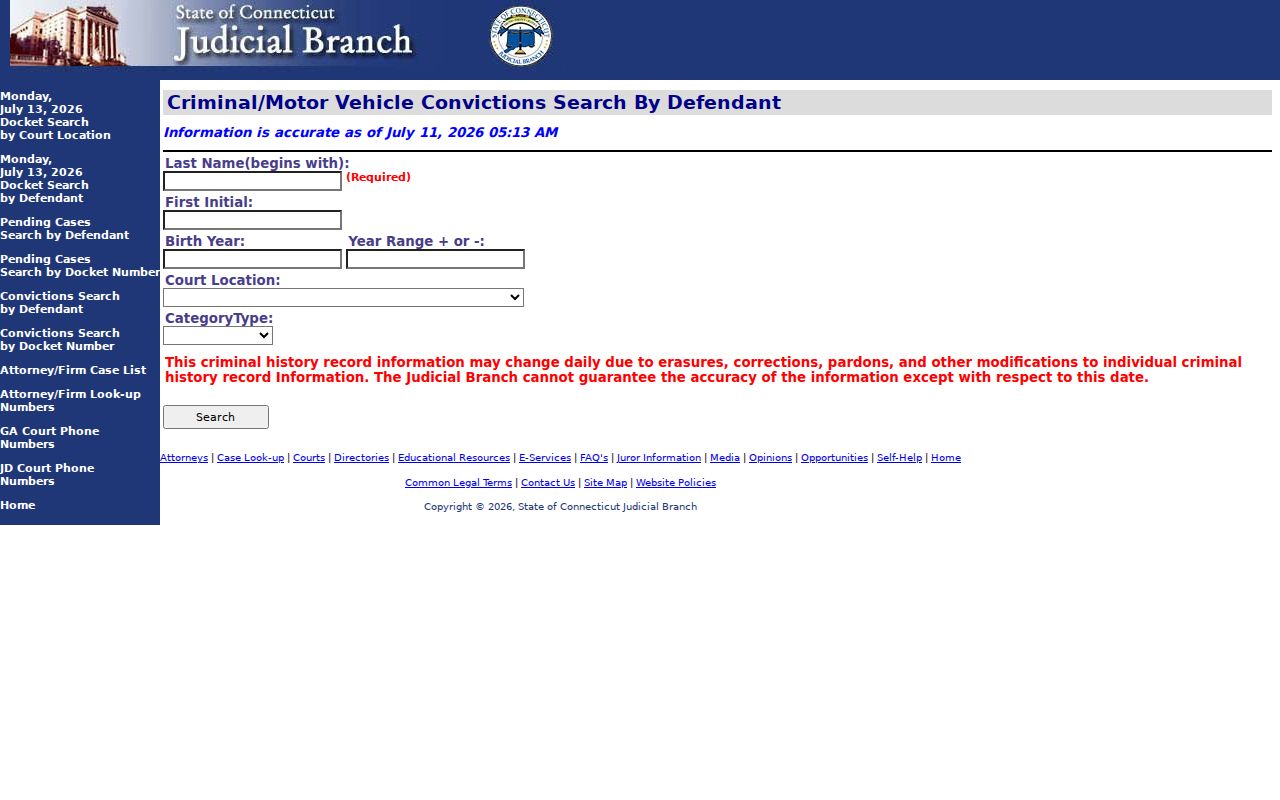
Conviction docket searches are most useful after disposition, while pending docket searches are better for open criminal or motor vehicle matters.
Note: A missing conviction search result may reflect age, erasure, sealed status, juvenile status, or a lookup limit.
Middlesex County Courts With Dockets
Middlesex docket access follows Connecticut's court structure. The Superior Court is the trial court for civil, family, criminal, motor vehicle, juvenile, housing, small claims, and special-session matters. The local state courthouse is the Middlesex Judicial District courthouse in Middletown. Criminal arraignments, misdemeanors, felonies requiring geographical area handling, motor vehicle cases, and daily criminal dockets may route through Middletown Geographical Area 9.
Probate Court dockets are separate. Middletown Probate Court, Region #14 Probate Court, and Saybrook Probate Court serve different Middlesex towns for estates, trusts, conservatorships, guardianships, and related matters. Federal cases are also separate and use District of Connecticut systems, not the state Judicial Branch lookup.
Civil and family dockets do not use the same daily criminal screen. They are searched through the Superior Court civil inquiry tools by party name or docket number. Family cases can include divorce, custody, support, relief from abuse, and name-change matters. Public lookup may identify the case and events, but it may not expose every document or sensitive detail.
- Middlesex Judicial District Superior Court handles civil, family, serious criminal, juvenile, child protection, court service center, and law library functions.
- Middletown Geographical Area 9 handles criminal arraignments, misdemeanors, felony GA handling, motor vehicle matters, and daily criminal or motor vehicle dockets.
- Connecticut Probate Courts handle probate dockets by town and district, not by a single Middlesex County probate clerk.
Sample Middlesex County Docket Fields
A docket entry should be read as a structured event record. The online lookup may show the case identifier, court location, party or defendant name, category, status, and hearing or event information. It may not include the full document text. The public search fields and result fields vary by civil, family, criminal, motor vehicle, and probate systems.
| Field | What It Shows |
|---|---|
| Docket number | The official case identifier used for lookup, clerk requests, and case tracking. |
| Court location | The court tied to the event, such as MMX-Middletown JD or Middletown GA 9. |
| Case category | The record type, such as civil, family, criminal, motor vehicle, housing, small claims, or probate. |
| Event entry | A filing, appearance, motion, order, hearing, continuance, judgment, sentence, or warrant-related event. |
| Hearing information | Date, time, location, and courtroom or docket data when displayed by the daily docket. |
| Status or disposition | Pending, disposed, judgment entered, dismissed, convicted, nolled, stayed, sealed, or erased where public. |
| Financial entry | Fine, fee, restitution, bond, cost, or payment status when public in criminal or motor vehicle contexts. |
Docket vs. Full Case Record
A docket is a road map of the case. It can show what was filed, when a court event occurred, whether a case is pending, and what outcome is public. The full case file is the set of documents behind that road map. In Middlesex County, the public lookup often helps identify the case before a person contacts the clerk for the actual filing or certified copy.
| Docket | Full Case Record | |
|---|---|---|
| Format | Chronological event list, calendar entry, or case summary. | Filed documents, written orders, pleadings, and certified copies. |
| Access | Often available online through Judicial Branch lookup systems. | May require a request to the Clerk of the Superior Court. |
| Use | Track dates, status, location, and case progress. | Review legal filings or obtain official proof. |
| Limits | May omit sealed, erased, juvenile, or document-level details. | May include restricted material that is not public without court authorization. |
Read Middlesex County Dockets
Common terms help make the docket readable. An appearance identifies an attorney or self-represented party. A motion asks the judge for an order. A continuance moves a hearing or deadline. A disposition is the outcome of a case or charge. A nolle is a prosecutor's decision not to proceed on a charge at that time. A sentence is the punishment after conviction.
When a docket is missing or incomplete, use the fallback chain. Check the correct case type first. Confirm the spelling and docket number. Try the statewide location and the local Middletown filters. For older files, certified copies, sealed-record questions, or records not online, contact the Clerk of the Superior Court at the Middlesex Judicial District courthouse. The public lookup is helpful, but the clerk maintains the official court file.
Docket timing also matters. A hearing can be continued, a plea can change the next date, and a warrant event can alter the calendar. Criminal and motor-vehicle conviction results are not the right tool for a pending case, and a daily docket is not a long-term archive. Use the pending defendant or docket-number search for open cases, the daily docket for scheduled appearances, and the conviction search only after disposition.
For probate dockets, start with the Probate Court case lookup and the correct district. For federal dockets, use PACER or District of Connecticut CM/ECF. Mixing systems is a common source of false negatives because a Middlesex Superior Court docket, a probate estate, a DMV matter, and a federal case can all involve the same person but live in different databases.
Missing Middlesex County Dockets
A missing docket should be checked against the research limits before concluding that no case exists. The record may be in the wrong case category, filed under a different name spelling, assigned to Middletown GA 9 instead of Middlesex JD, too new to appear, or too old for a public conviction display. It may also be a probate, town vital-record, DOC, DMV, or federal record rather than a Superior Court docket.
Confidentiality can also explain a missing result. Juvenile matters, youthful offender cases, erased criminal records, sealed files, adoption records, protected family details, and mental-health material are not ordinary public docket entries. If official proof is needed, use the docket number or party information and contact the Clerk of the Superior Court, the correct Probate Court, or the federal clerk that holds the record.